Tuesday, May 24, 2011

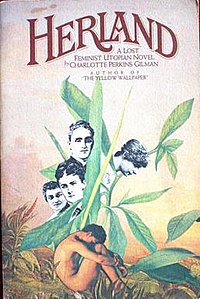
Herland, and With Her in Ourland, Charlotte Perkins Gilman

Charlotte Perkins Gilman, probably best known in a literary sense for her short story, The Yellow Wallpaper, wrote a quite startling two-part novel about a feminist utopia, heavily critiquing society along the way.  While some of her ideas are a product of her time (it's a little bit eugenics, and she's not up with intersectionality in her examination of oppressions), Herland, and the second part, With Her in Ourland, is a riveting read that has much to offer a [post?]modern feminist.  I found this one on the fab Year of Feminist Classics blog, their post on Herland is here.

Herland was published in parts in Gilman's self-edited periodical in 1915.  The book's pretext is the discovery, by three male explorers, of a cut-off and isolated land populated only by women, that has existed for over 2000 years.  Their subsequent behaviour and adaptation (or lack thereof) within this society during their stay allows Gilman to explore this utopia, which in turn is the vehicle for her to provide some stark and powerful critique of her [our] own society.  The story is narrated by one of the explorers, Van Jennings, a sociologist (see, what's not to love!).  Van takes an enlightened road of reluctant acceptance, while the other two men either capitulate totally (which seems to be taken as weakness), or react violently against the female utopia (which is condemned).

The focus of the utopia is a central idea of motherhood, backed up by a community-based semi-tribal social system.  Critique is often levelled at Gilman's idealisation of motherhood in Herland, but if taking motherhood as an organising social force, I pretty much agreed with her.  The birth, education and value of children in our society seems tragically poorly valued to me.  If the concept of "motherhood" here is less about the "inate" desire of every individual woman to have a child [problematic], and more about the role, value, and all round key importance of motherhood [/parenthood] in general as a social institution, then yeah, I'm pretty much there with her.  A society built around the treasuring of the next generation can't help but be better than this one.  Right? 

With Her in Ourland is published as the sequel to Herland, though arguably it is simply the second part of that work.  Published serially in 1916, it tells of the return of two of the explorers to "Ourland" society, accompanied by one of the Herlanders.  This volume moves from utopia to dystopia, and is mostly conversations and observations between Van [explorer sociologist] and Ellador [the Herlander].  They tour the globe, from war-torn Europe, to disaffected America, providing a powerful and insightful commentary on the world of the time. The bulk of the book is focussed on America, as both a hope and a disappoinment.

Herland is the stronger of the two books, with what is more recognisably a narrative.  Ourland becomes pretty much a series of sometimes dry essays in conversational form, and though I thorougly enjoyed them, I freely confess that I am a sociologist by trade and this might have been a telling factor.

Both works have lapsed into obscurity, though Herland was republished in the 1970s, and is more widely available today.  Both books have been critiqued in recent years, largely for Gilman's treatment of other social issues, including race, religion, and the "natives" referred to throughout.  As a product of her time, though, Gilman's take on racism remains liberal. The other main sticking point for me was the complete lack of womens sexuality in the book, the women were asexual.  Bit of a flaw, there [!!].  It was part and parcel of her idealisation of Woman. 

While written in 1915/16, many of Gilman's insights remain uncomforably current.  Here are some interesting quotes:
A neat description of the sociological imagination: "...I didn't care what it was they talked about, so long as it connected with human life, somehow.  There are few things that don't." Herland: 147 of 8636.

"[Herlanders]...were strikingly deficient in what we call "femininity."  This led me very promptly to the conviction that those "feminine charms" we are so fond of are not feminine at all, but mere, reflected masculinity - developed to please us because they had to please us, and in no way essential to the real fulfullment of their great process."  Herland: 1538 of 8636.

It remained true that the Church, any church, in any period, had set its face against the people's learning anything new; and as we commonly know, had promptly punished the most progressive.  With Her in Ourland, location 1368 of 2550.

"Here you are, a democracy - free - the power in the hands of the people.  You let that group of conservatives saddle you with a constitutions which has so interfered with free action that you've forgotten you had it.  In this ridiculous helplessness - like poor old Gulliver - bound by the Lilliputians - you have sat open-eyed, not moving a finger, and allowed individuals - mere private persons - to help themselves to the biggest, richest, best things in the country."  With Her in Ourland, location 1716 of 2550.

On the home/family structure: "What do you want done?" I asked, after a while.
"Definite training in democratic thought, feeling and action, from infancy.  An economic administration of common resources under which the home would cease to be a burden and become an unconscious source of happiness and comfort.  And, of course, the socialization of home industry."  With Her in Ourland, location 1728 of 2550.
Interesting stuff!  I'd recommend both works as powerful critiques of the society of the time (and, let's face it, most of this stuff remains awfully current), and as important works in the feminist canon.  Herland in particular is the more accessible work, and available free in various formats.  Pick up a copy!

8/10


Herland is available at Project Gutenberg.  It was a Kindle for iPad read.

With Her in Ourland is available in a special edition, which was relatively pricey on Amazon (but I'd already commited to read it, so had to pay up!).  It was a Kindle read for iPad.

Saturday, May 21, 2011

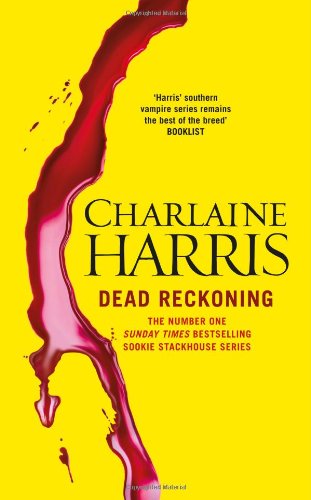
Dead Reckoning, Charlaine Harris

I've enjoyed the quick-reading frolics of the True Blood books (and am a big fan of the TV Series), and always read along when a new one comes out.  It feel nicely into my "let's not strain my brain" books which is all I've managed lately. Sure, Dead Reckoning furthers the series' story (kind of) and there's the usual sassy Sookie (though now, apparently, with less sass), complete with supernatural adventures, and sexy vamps.   But this installment falls very flat.

Plotwise, well, if you haven't read the series yet, you're probably not interested.  If you're a fan of the series, there are no big reveals here, things are plodding by as usual (though Bill and Eric seem to have swapped personalities).  So, I'm just gunna whinge in a spoiler-y way: The whole Pam sub-plot was just odd, completely out of the blue, and seemed to go nowhere and serve no purpose.  There was yet another evil boss vampire to vanquish.  There was a WTF moment with Alcide.  The faerie stuff was all over the place, and didn't mesh with the rest of the plot. Why was Hunter in this at all?  WTF was going on with the whole de-bonding thing?  The whole book was jumpy and lacked cohesion, and there were more unnecessary subplots than I can list (yes, there were more than those above). 

This book feels like Harris is just phoning it in.  Dead Reckoning was wooden, predictable, more than a tad confused, and not at all original.  Even Sookie was not on her game, I like her more tough and sassy and less Christian moralistic and weepy.  The True Blood series has been a nice addition to the vampire/supe canon, but this installment was lacklustre.  Sure, we've all still gotta read it, and I may as well confess I'll still read the next one, too, when it comes out, but it wasn't as fresh as the rest of them (mostly) are.

Verdict: more than a tad stale.  Only read it if you've got this far in the books already (and we all know you just have to keep going, no matter what).

Oh, I read this great review on Goodreads while looking for a picture of the cover, and can't resist a link.

5/10

This was a Kindle for iPad read.

Sunday, May 15, 2011

What do you read when you're not reading a book?

Blogs, of course!  It's trite but true to say that sometimes that ubiquitous "stuff" gets in the way of blogging, and reading.  I've read a grand total of two and a half books in the past month, and all of those were only 200 pages or so.  By which I mean I've read hardly anything.  Life had other plans.

But, I can still be spotted gadding about reading stuff on the iPad, so what on earth has distracted me during those dull quiet parenting moments?  

Why, blogs, of course! I sometimes worry at the number of blogs I'm subscribed to/following, it's nearing 400 *gasp*!  Here are a few gems from my feedreader:

I always get an interesting evening's clicking out of the link round ups at Kittling Books.

I love the poetry and life at a moon worn as if it were a shell; the thoughtful and insightful perspectives on children, development, and play at Teacher Tom, and the awesome sociological insights at Sociological Images.

I'm enjoying reading along with A Literary Odyssey, The Trick is to Keep Reading, and the New Dork Review of Books.

As for life, I want more of this:

MORE
And less of this:
LESS!!

Sunday, May 1, 2011

On book blogging slackness...

Hmmm....Could this be a reason?


We moved all the books into the new library space.  It's going to be a family room/library area (yay!) but currently looks like this.  You can see my TBR pile if you embiggen the picture, it's in the green clothes basket on the far left.  :D

Though I have no excuses for not posting anymore, as we finally put out study together again (slightly untidy still, here, but you get the idea).  Far side is me, near side is teenager.


Interesting times!  I'm planning on rehoming a LOT of books, most that I now have in digital format, and lots we just won't read again.  It'll be hard, I used to have 14 bookcases of books, with several more boxes in storage, and we now have 6 bookcases out (and some will go to storage, young adult and kids for when Lolly wants them, some of my professional library).  That's a LOT of culling to be done.  Wish me luck!

Friday, April 29, 2011

Ruth Readalong (Elizabeth Gaskell)

I haven't read Ruth yet, it's one of the few Gaskell works I have left to read, so this read-a-long at Gaskell Blog sounds ace, care to join up?


The annotated discussion starts May 15!

Wednesday, April 27, 2011

Lost in a Good Book, and the rest of the Thursday Next Series, Jasper Fforde

Lost in a Good Book was, as Jasper Fforde shares on his website, an unplanned sequel, demanded by his publishing company.  So, it takes a different angle to the first book, much expanding the available world to explore.  Basically, it is possible to jump into fiction, or Bookworld and bookjump between fiction.  Thursday Next becomes involved with Jurisfiction, the fiction policing agency.

This is a whole world of awesome right here, and Fforde explores it with style.  I love the bookworld, and Jurisfiction is just a genius idea for exploring it.  Any book that can convincingly include Miss Havisham as a main character has my vote.

I love the political and social commentary in the alternate Britain "real" world, too.  The Goliath Corporation is particularly awful (ly hilarious).


I've cheated somewhat by smooshing the rest of the series into this review.  Once we get to Lost in a Good Book, we've got the gist of the rest of the series from here [which are: The Well of Lost Plots; Something Rotten; First Among Sequels; One of Our Thursdays is Missing].

What more to say?  These are great fun, smart, witty, page turners, with plenty to think about and feel cool about knowing (did I mention there are classics littered all through these?).  Most bookish peeps are going to enjoy them, though you don't have to be bookish to like Fforde's style.  Thursday Next is one awesome heroine, she's smart, funny, and solves everything.  In the series she also has kids.  So it's quite the feminist win, too.

Read 'em.  They're fun.

7.5/10 overall (none are as awesome as the first).

These were a range of purchased "real" books, and Kindle ereads.

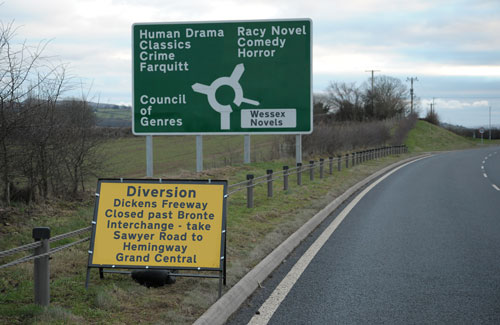
[All pics are from Jasper Fforde's site, click through to view]

Monday, April 25, 2011

The Eyre Affair, Thursday Next Series, Jasper Fforde

I've been reading the Thursday Next BookWorld series as some great bookish entertainment for the past few weeks, when reading has been slow and life has been busy.  The Eyre Affair is everything the blogosphere says it is, witty, entertaining, literary, laugh-out-loud funny.  If you haven't read this already, put it on your list.  And click here for Fforde's site [seriously, click there, it's hilarious].  Take note that the book contains total spoilers for Jane Eyre, so if by chance you've not got to that one yet, and want to be surprised, don't read The Eyre Affair. 

I don't have a lot to add to a strong recommendation to read this one, really.  It's a snappy, clever book set in an alternate reality Britain, where book people are real.  The central character, Thursday Next, works for a Special Ops unit in Literary Detection.  The classics are front and centre in this version of reality, and when circumstances unfold that threaten the very existence of Jane Eyre (from the novel, that is), it's high crime indeed. 

Definitely check it out. Fforde is a prolific author, and has a number of other series I'm going to check out, his style is witty, well read, and snappy, reminded me of Hitchhiker's Guide.  Good stuff, and British not American, which is nice to see occasionally.  (Is it just me, or do all the best comedies come from the UK?).

This was a library read.

9/10 for a great idea, snappy plot, clever dialogue, and awesome use of the classics.